Pratik Kamble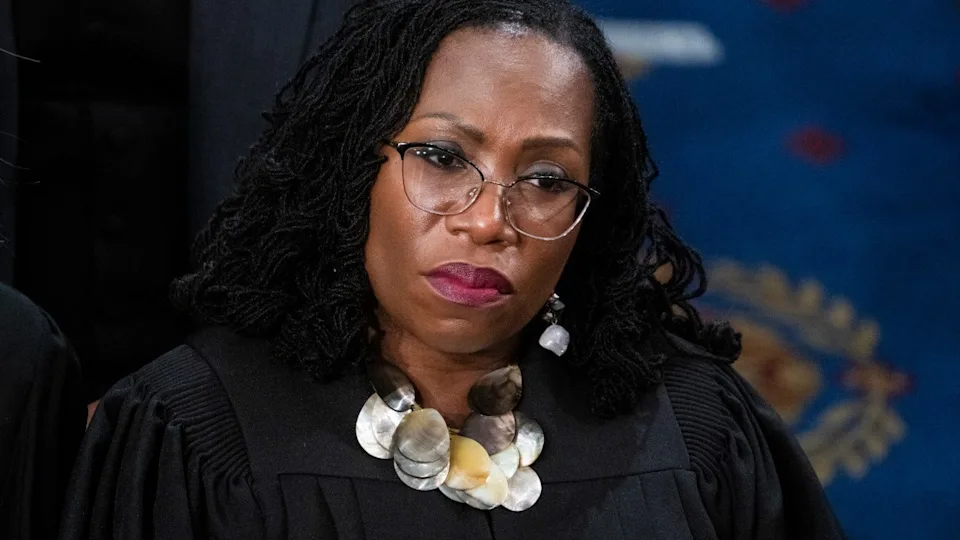
Justice Jackson Draws Criticism for Voting Rights Analogy
Supreme Court Justice Ketanji Brown Jackson has come under fire following remarks made during a high-profile voting rights case, where she compared racial voting challenges faced by Black Americans to physical disabilities, suggesting that both require “specific, structural remedies.”
The comments, delivered during oral arguments on Monday, centered on race-based districting and how courts should interpret the Voting Rights Act (VRA) when evaluating minority representation.
“When individuals with disabilities face barriers, we build ramps,” Jackson said. “When Black voters face systemic barriers, the law must create the same kind of access.”
While Jackson’s analogy was intended to underscore proactive inclusion, critics across the political spectrum accused her of trivializing racial disparities and advocating unconstitutional racial preferences.
Context: The Voting Map Dispute
The case in question involves a challenge to congressional redistricting maps in several southern states, where civil rights groups argue that Black voters are being unfairly diluted through partisan line-drawing.
Justice Jackson’s remarks were part of a broader discussion about whether race-conscious remedies are still necessary decades after the VRA’s enactment.
She suggested that ignoring racial data entirely might reinforce structural inequality rather than eliminate it.
“The framers of the Reconstruction Amendments understood equality as requiring action, not indifference,” she noted.
Conservative Pushback Intensifies
Conservative legal scholars and politicians were quick to condemn the analogy.
Former federal judge J. Michael Luttig called it “deeply misguided,” arguing that racial and disability law function under entirely different constitutional frameworks.
Sen. Ted Cruz (R-Texas) criticized Jackson on social media, calling her statement “an insult to both disabled Americans and Black voters.”
“The Constitution guarantees equal treatment, not race-based engineering of election outcomes,” Cruz said.
Several commentators also warned that Jackson’s remarks could reinvigorate debates over judicial activism and the proper role of the Supreme Court in shaping social policy.
Supporters Defend Jackson’s Remarks
Progressive activists and civil rights advocates defended Justice Jackson, arguing that her comparison highlighted the need for structural fairness rather than preferential treatment.
Sherrilyn Ifill, former president of the NAACP Legal Defense Fund, praised Jackson’s comments as “a necessary reminder that equality requires accessibility — not colorblindness.”
Others emphasized that racial discrimination in voting remains a reality, citing recent federal court rulings in Alabama and Louisiana that found states in violation of the Voting Rights Act.
Broader Implications for the Supreme Court
Justice Jackson’s remarks come amid a growing debate over the future of race-conscious policies in America.
Following the Court’s recent decision striking down affirmative action in college admissions, many observers view this case as a potential turning point for race-based considerations in voting law.
Legal analyst Jeffrey Rosen noted that the controversy underscores the divide between formal equality — treating everyone the same — and substantive equality, which acknowledges the need for compensatory measures.
“Jackson’s analogy may have been provocative,” Rosen said, “but it forces a conversation about what fairness actually means in a democracy.”
Public Reaction and Political Fallout
Online, the debate has polarized opinion. The hashtag #KetanjiBrownJackson trended nationwide, with reactions split between those who applauded her candor and others who accused her of injecting ideology into judicial reasoning.
Republican lawmakers hinted that Jackson’s comments could be used as fodder in future congressional hearings on judicial conduct and constitutional interpretation.
Meanwhile, Democrats rallied around her, framing the backlash as a politically motivated attack on one of the Court’s most vocal defenders of racial justice.